Blog
17 Feb 2026/
Company News/ Real Estate Industry/

Announcing our €8M Seed round

Optiml closed an €8 million Seed round to pioneer Real Estate Decision Intelligence (REDI) — the decision-steering layer that helps real estate investors and managers defend NAV and yields, optimize CapEx and IRR, and manage transition risk from underwriting to exit, even as constraints change.


Evan Petkov

The Missing Layer in Real Estate: Real Estate Decision Intelligence

Real estate is facing converging pressure from refinancing, regulation, investors, and occupiers yet much of the sector remains in a holding pattern, even as asset values come under increasing strain. Higher rates and transition risk are turning into practical, high-stakes questions: what is financeable, what is leasable, and what is defensible in IC and lender processes?

The issue is that the current toolset hasn’t helped the industry move from pressure to action. Spreadsheets and static reports don’t scale across portfolios and break the moment assumptions change. Backward-looking ESG reporting platforms optimize disclosure, but don’t produce decision-grade, forward-looking evidence on what to fund, when to fund it, and with what cashflow impact. Retrofit planning tools often stop at pathways or measure lists without turning them into financeable, sequenced investment plans. And asset management suites run workflows and record-keeping, but don’t solve cross-asset capital allocation and trade-offs under real constraints.

At the same time, operating models are being reshaped. Asset and investment managers are facing margin compression, consolidation pressure, and in some cases, existential risk as business models get squeezed. And for consultancies, one-off ESG projects and report-driven engagements are no longer enough: clients increasingly need repeatable, decision-grade outputs that hold up in financing and governance and can be refreshed as conditions change.

What institutional investors, asset managers, and their consultancies are looking for is a new decision layer: which buildings to hold, sell, retrofit, or repurpose; where to allocate capital and with what impact (NAV, NOI, IRR, EUI, CO₂e) and in what sequence as financial, operational, and regulatory conditions evolve.

We built Optiml to fill this unmet need and help move the sector out of standstill by creating a new software category: Real Estate Decision Intelligence (REDI). REDI turns transition ambition into underwriteable decision records from underwriting to exit.

Decisions that define performance - under real-world constraints

REDI is built for the decisions that move portfolios out of standstill. It turns transition ambition into underwriteable decision records that stand up in governance, where ICs, boards, lenders, and LPs increasingly demand defensible CapEx trade-offs that prove what is financeable and executable, not backward-looking snapshots, benchmark curves, or one-off reports that misallocate scarce capital.

In practice, real estate companies now need to make five recurring, portfolio-wide decisions  and REDI is designed to power each one:

  • Hold / Sell / Invest / Retrofit / Repurpose: Which path creates the best risk-adjusted and value-creating outcome, and why now vs. later?
  • Capital allocation across the portfolio: Where should scarce Capex go first to maximize value creation (NAV, NOI, yield, IRR) while staying on-path?
  • Refinancing readiness: What scope, timing, and sequencing protects DSCR/covenants and removes execution doubt for lenders and credit committees?
  • Execution realism: Which measures are truly deliverable given lease events, tenant constraints, procurement capacity, and operational disruption?
  • CapEx staging and sequencing: How do we phase investment without breaking budgets, business plans, or operational resilience,  and still meet transition requirements?

These decisions only become “underwriteable” when they’re computed against the constraints that dominate real portfolios: refinancing dates and terms, DSCR/covenants, lease expirations and rent steps, Capex budgets and procurement limits, regulatory deadlines, asset class and country differences, and transition targets, and when they can be refreshed the moment those constraints change.

Powered by proprietary optimization algorithms and our own IP built on a decade of ETH Zurich research, Optiml goes beyond classic “AI insights” and static scenario tools by computing decision-grade outputs under constraints: portfolio capital allocation maps, sequenced Capex pathways, and refinancing readiness packs. Every output is underwriteable: explicit financial linkages (e.g., DSCR impacts, IRR scenarios, cashflow timing), versioned assumptions and scenarios, and audit trails that support approvals, execution, and repeatable refresh across global portfolios.

Dr. Evan Petkov, Co-Founder and CEO, built REDI for this crossroads: "Leaders turn complexity into alpha with data-driven strategies they can underwrite, generating returns while governing toward investors."

A seamless decision layer - not another system users have to feed

Most real estate teams are already overloaded with tools and the real friction isn’t a lack of dashboards. It’s the work required to make data usable and decisions defensible. REDI is designed to remove that burden.

Unlike traditional platforms, REDI operates on the reality of real estate data and workflows. It can ingest and structure unstructured inputs (for example audit reports, EPCs, lease documents or Capex plans) instead of forcing teams to re-enter everything into templates. It supports complex, cross-functional workflows spanning investment, portfolio, asset, sustainability, development, and finance teams  with governance, versioning, and approvals built in.

This is where the underlying technology matters. We combine optimization and energy simulation methods with agentic AI to take on the heavy lifting: structuring inputs, filling gaps, reconciling inconsistencies, and keeping decision records current as constraints change. The result is a low-friction experience teams keep using because it reduces workload instead of adding to it.

REDI also meets enterprise security requirements (ISO 27001, SOC 2) and fits into existing technology stacks. Optiml integrates with systems of record and data sources, so REDI becomes a decision layer on top, not a rip-and-replace project. And where execution depends on external partners, service providers such as property and facilities managers, as well as consultancies, can contribute inputs, validate assumptions, and support delivery, while the decision record stays auditable and consistent portfolio-wide.

Jordi Campos, Co-Founder and CTO, adds: “We designed REDI for explainability and accuracy at portfolio scale so every recommendation can be traced back to inputs and constraints, and withstands rigorous lender and IC scrutiny.”

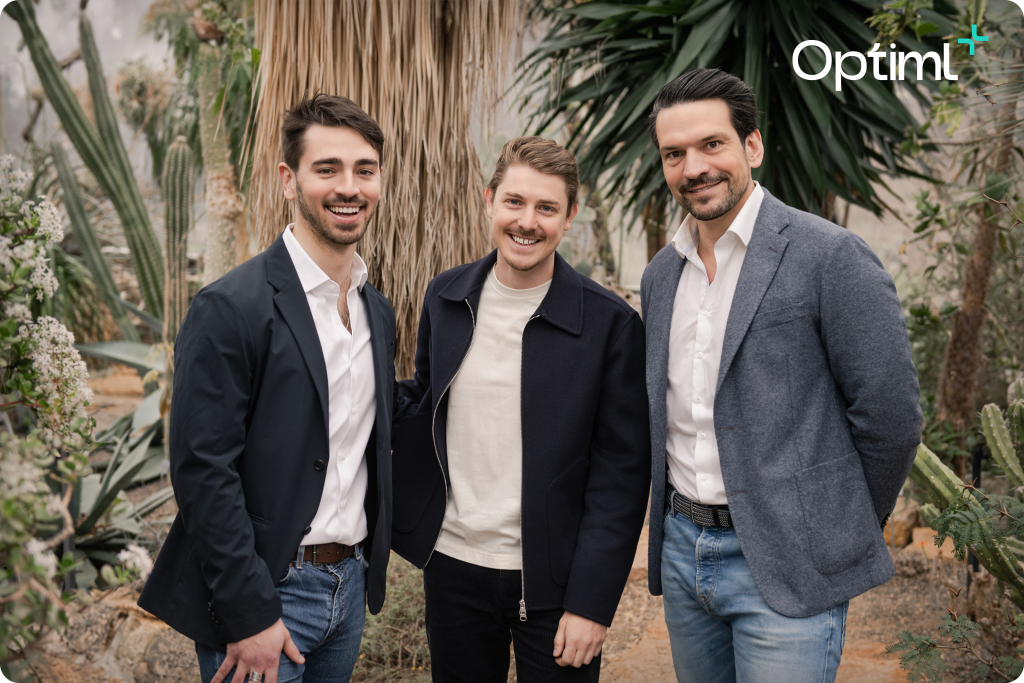
Co-Founders Jordi Campos (CTO), Dr. Evan Petkov (CEO), and Nico Dehnert, MRICS (CCO)

Rapid adoption by leading real estate companies validates REDI

REDI isn’t theoretical, the market is adopting it. Some of Europe’s most innovative, performance-driven real estate investors, asset managers, and consultancies have chosen Optiml as the decision layer to move from transition ambition to underwriteable, portfolio-wide CapEx decisions.

Optiml is now used by teams including Patrizia, Catella, Empira, CTP, Westbridge / Agradblue, and Longevity Partners,  a clear signal that REDI is emerging as the missing category between reporting and execution.

And the upside isn’t only “better decisions.” In practice, REDI users can remove 30–50% of Green Capex by prioritizing what’s truly required and sequencing it efficiently, while more actively steering the value drivers that matter: NOI, operating performance, CapEx timing, cap rate defensibility, NAV, and distribution yield. Just as importantly, REDI helps teams take out operational inefficiencies by standardizing decision workflows and refresh cycles across portfolios, critical as margins compress and the industry consolidates.

We exceeded our 2025 forecast, which we view as a proof point that the market has been waiting for a decision-grade category, not another dashboard, report, or siloed tool. To accelerate further, we’re expanding beyond our current footprint across 20+ countries in Europe and the U.S., and we’re hiring across our hubs in Zurich (HQ), London, and Germany. Our goal is simple: accelerate growth and capture the tailwind as the industry moves from standstill to decision-making,  with REDI as the enabling layer.

As our Co-Founder and CCO Nico Dehnert puts it:  “REDI empowers our clients to actively defend NAV and yields, cut unnecessary Capex and increase IRR, and meet transition goals while decisions stand up in IC and lender scrutiny”.

Capital for the REDI inflection

Our €8M Seed round is co-led by KOMPAS VC and Planet A Ventures, and supported by BitStone Capital, The Bau Ventures, Innovation Endeavors, and leading angels in real estate and AI fuels our next phase of market expansion and product depth.

KOMPAS’ Andreas Winter-Extra sees “impressive momentum confirming REDI as critical for the asset class.” Planet A’s Christoph Gras calls it “scientific discipline turning capital choices into bankable ROI and climate outcomes.”

About Optiml

Optiml is pioneering Real Estate Decision Intelligence (REDI) --- a new software category enabling institutional investors, asset managers, owners and their consultants to continuously optimize hold, sell, invest and Capex sequencing decisions across real estate portfolios. Optiml combines AI, finance and governance expertise to give real estate leaders a transparent and auditable decision system built for modern constraints. Visit www.optiml.com to learn more.

© Optiml AG 2026

contact@optiml.com

🇨🇭 Tessinerplatz 7, 8002 Zurich, Switzerland

🇩🇪 Munich, Germany