Why real estate decision intelligence is replacing ESG reporting
The real estate industry is undergoing a structural shift.
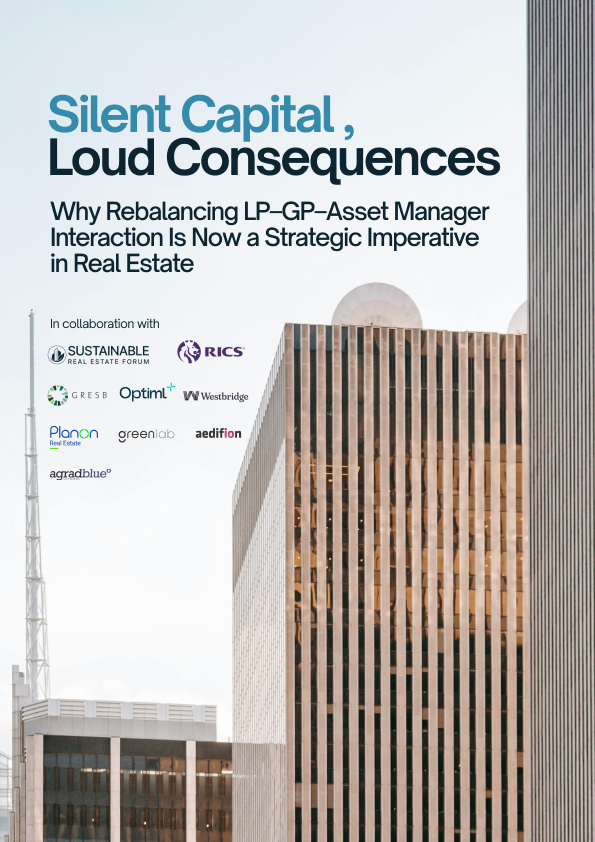
A new white paper,"Silent Capital, Loud Consequences", developed by the Sustainability Real Estate Forum together with RICS, GRESB, Planon, Westbridge, Agradblue (part of Westbridge),Greenlab, Aedifion, and Optiml, highlights a system under pressure:
- Increasing stranded asset exposure
- Tightening capital constraints
- Limited decision visibility for LPs (who provide ~65–75% of capital)
At the same time, most real estate organisations still rely on ESG reporting tools and fragmented data systems.
The shift: from reporting to decision systems
The industry is moving through five key transitions:
- ESG reporting → financial decision-making
- Static reports → real-time, decision-grade transparency
- Leverage → operational performance
- Insight → decision authority
- Fragmented tools → integrated investment intelligence
This is not just digitalisation.
It is a shift toward decision systems, systems that connect building data, financial outcomes, and real-world constraints into investment-grade decisions.
Why ESG reporting is no longer enough
Traditional ESG and reporting approaches fail at the point that matters most:
investment and refinancing decisions
- Not linked to cash flow and returns
- Not auditable or traceable
- Not usable under IC or lender scrutiny
This leads to delays, rework, and conservative capital allocation.
The rise of Real Estate Decision Intelligence (REDI)
At Optiml, this shift is defined as:
Real Estate Decision Intelligence (REDI)
- Building-level reality (systems, condition, energy, constraints)
- With financial outcomes (NOI, NAV, IRR, DSCR)
- Under real-world constraints (refinancing, leasing, regulation)
The output is not a report.
It is a decision pack, defensible, auditable, and refreshable.
What this means for real estate investors
Real estate is moving toward a new standard:
- Decisions must be financially defensible
- Assumptions must be transparent and traceable
- Strategies must be executable and updateable
Value is no longer created by having a plan.
It is created by making decisions you can defend.
Learn how Optiml delivers real estate decision intelligence with REDI
Sustainability Real Estate Forum (2026), Silent Capital, Loud Consequences