Repeatable client delivery
Move from one-off reports to structured capital decision work.
















Start with available building evidence and develop options the client can compare in investment governance.
Make technical options, economics, and assumptions visible to ICs and Lenders.
Retrofit and Capex plans that update when the client’s constraints change.
Support recurring decisions beyond a technical audit.
REAL ESTATE DECISION INTELLIGENCE
Explore the platformFor our clients, the real value of technical ESG due diligence is understanding what property-level findings mean for capital requirements, transaction risk and the options ahead. A consistent decision-support workflow can help our teams turn that evidence into clearer advice, while professional judgement and client accountability remain central.


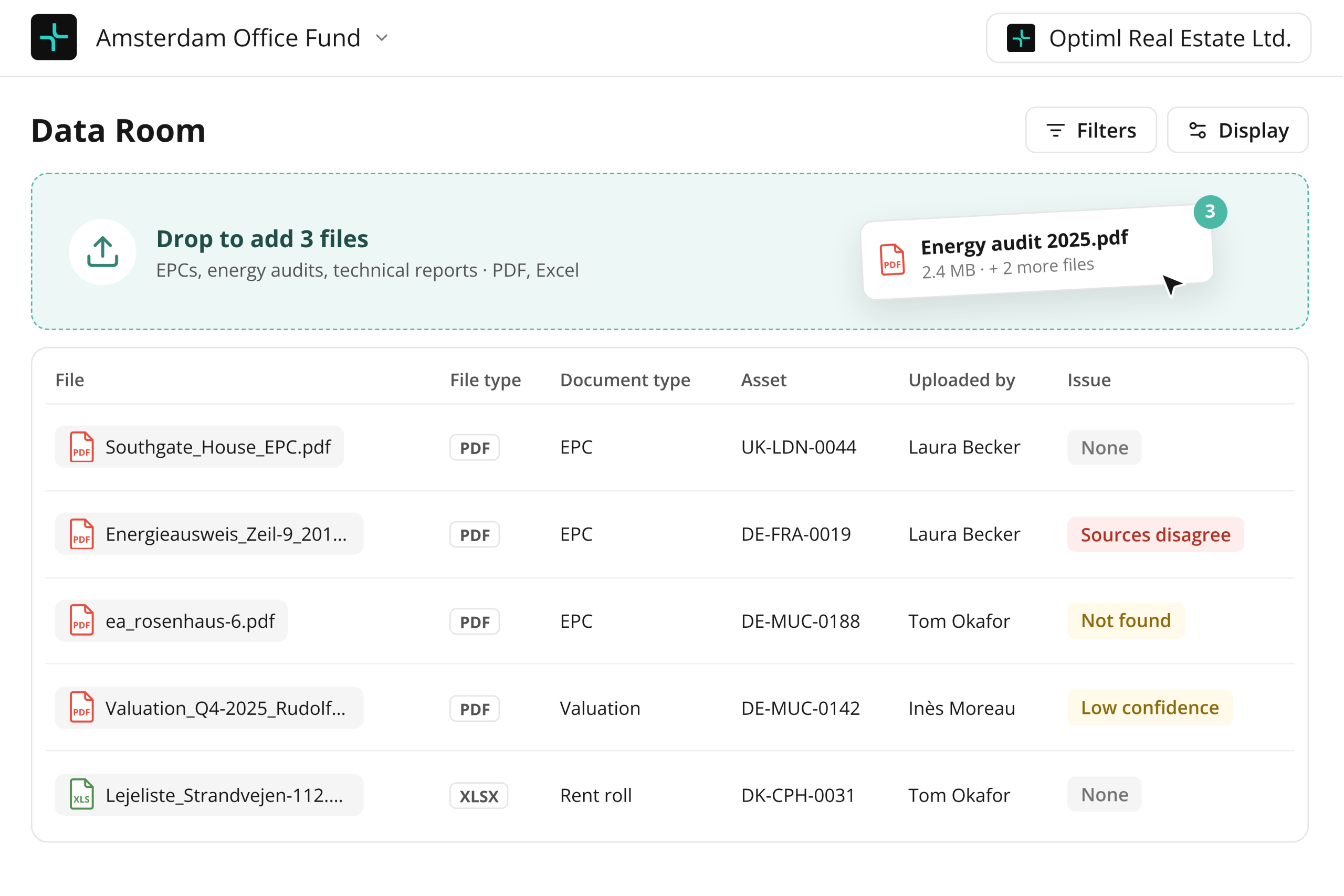
Drop a client’s EPCs, audits, and technical reports in one go and start the engagement from a structured asset record instead of a blank spreadsheet.
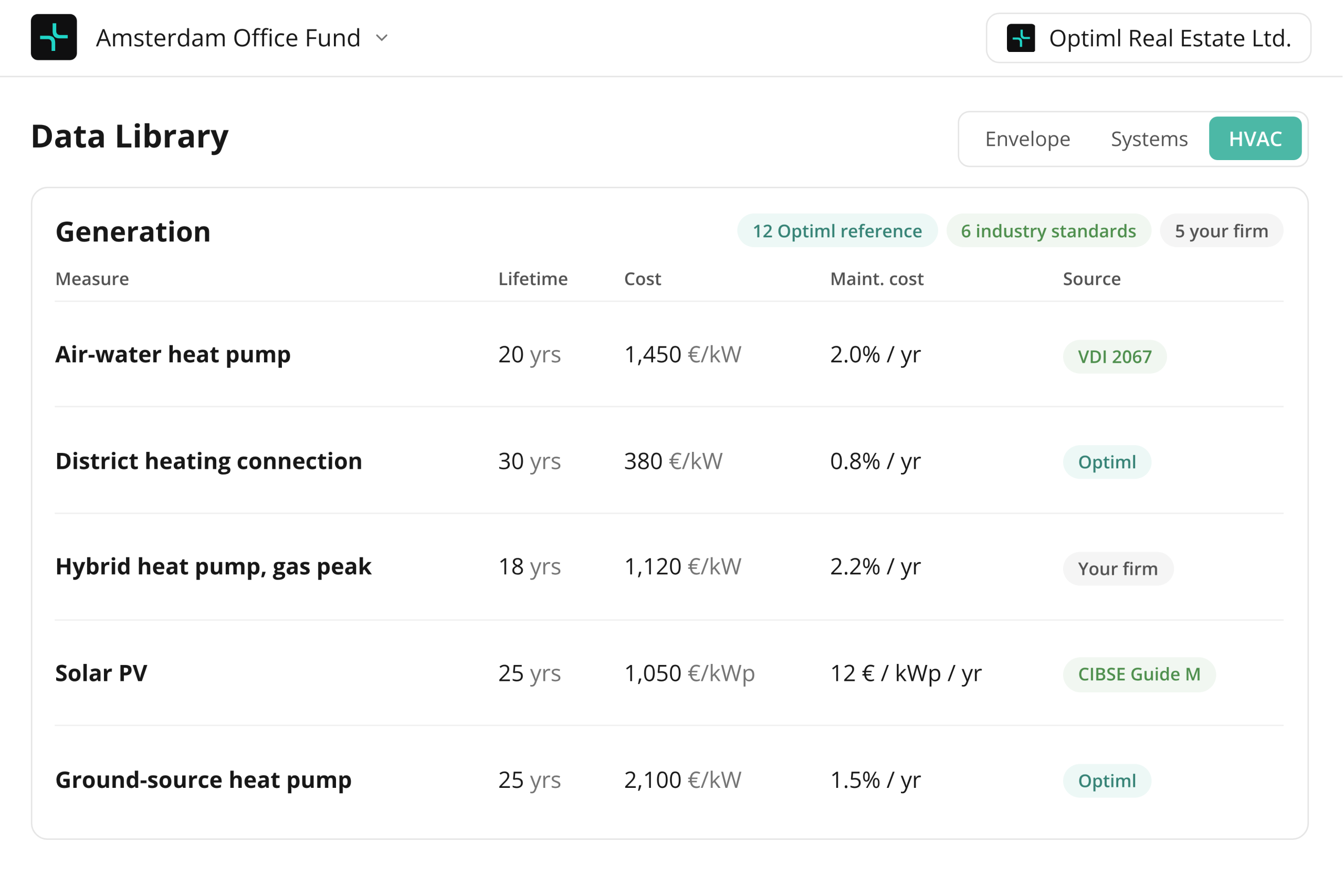
Shared assumptions and building-specific evidence across client assets while keeping your methodology and judgment clear.
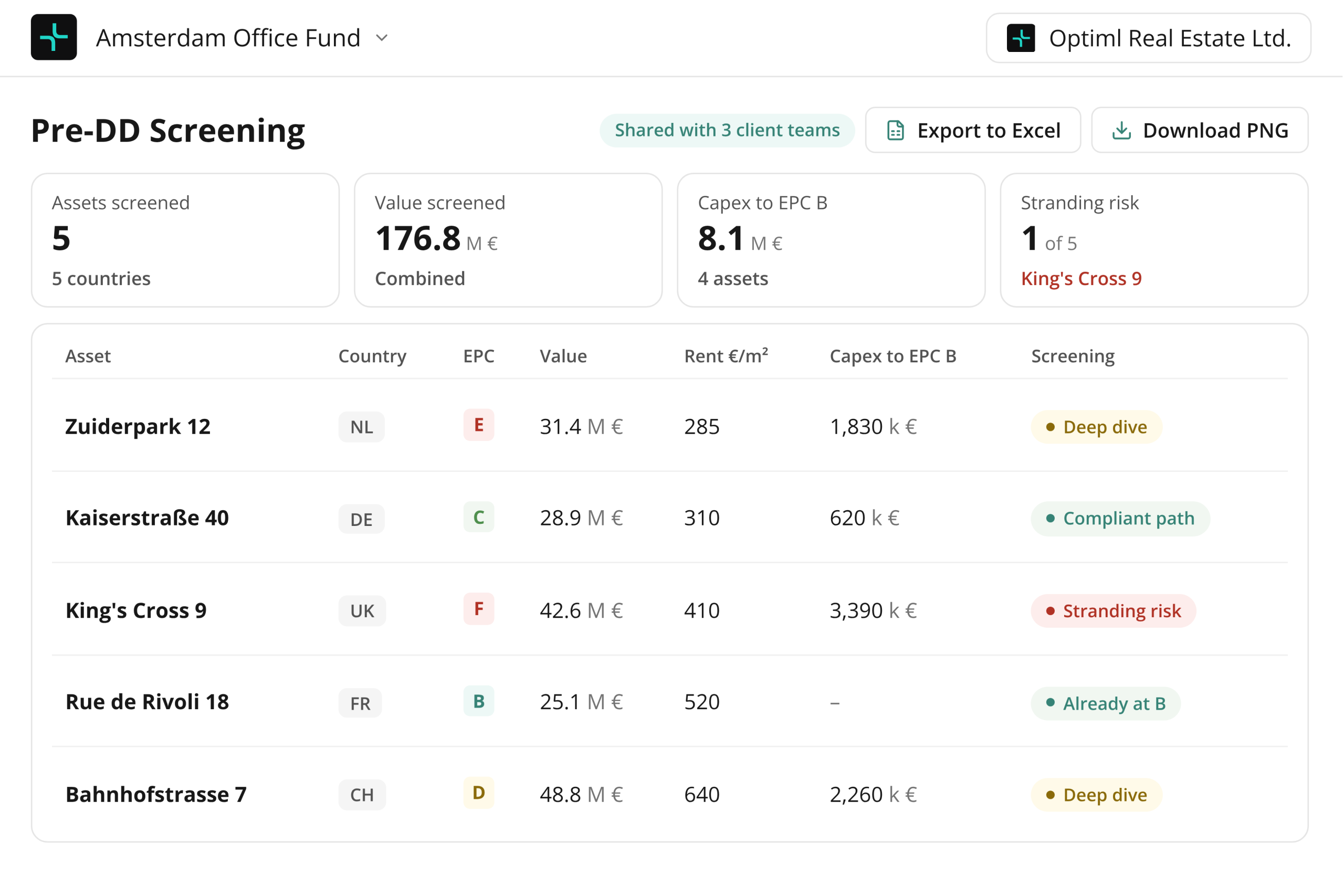
Present the client’s preferred and alternative asset plans in a consistent format, with decision assumptions and financial trade-offs ready for review.
How PATRIZIA uses Optiml across funds, asset classes, and investment transactions to identify more efficient Capex pathways, protect portfolio value, and make financial trade-offs visible to investors.
UK advisory team combined building evidence, indicative modeling, and professional judgment in a multi-property assessment, moving from fragmented source inputs to comparable EPC and retrofit scenarios on a transaction timetable.
Catella Investment Management used Optiml’s REDI platform to compare different investment and decarbonization pathways for Catella European Residential III (CER III).
How Pensionskasse der Bewag worked with FREO, pom+, and Optiml to compare investment pathways, identify a lower-capital approach, and translate portfolio climate ambitions into actionable planning.
Core+ office fund, GAV €800M, five European countries. Three fund strategies and asset-level hold, sell, and monitor plans to 2035.
No. Optiml is software, not an auditing service. It produces decision-grade results from the data available and shows where a site visit would tighten them most. Where a regulator or lender requires a signed-off audit, that remains the role of a qualified consultant, who can work directly in Optiml with the client's data.
Optiml uses a deterministic, physics-based monthly heat balance following the ISO 52016 and DIN/TS 18599 family of standards. It produces energy intensity (kWh/m²/yr) and carbon intensity (kgCO₂e/m²/yr) by energy carrier, end use, and scope, for the building as it is today and for every strategy.
Yes. With whole-building metered data, the model is calibrated to the building. With partial data, calibrated zonal projections are used. Without metered data, archetype priors apply. The basis used is declared for every output, so a reviewer can see whether a figure rests on measured, inferred, or assumed inputs.
On our validation set, simulated energy consumption lands within roughly ±10% of measured consumption, compared with the 10% to 30% under-prediction typical of conventional monthly methods. Where metered data is available, outputs can be calibrated to it, and the calibration basis is declared for every output.
Optiml builds a 3D model of every asset (LoD 1.3) from public and client data to simulate the real building rather than a generic archetype. Where floor plans and zoning information are available, a more detailed representation with individual zones, HVAC assignments, and construction layers can be created.
Capex benchmarks come from national cost databases such as BKI (Germany) and BCIS (United Kingdom) and from Optiml's own multi-source benchmark distributions at postal-code granularity, refreshed semi-annually. For each component and location we assemble cost data points from developers, consultants, and databases, apply the local median, and extrapolate to thinner locations through labor-cost drivers. All cost parameters remain editable.
See how Optiml turns your building data into capital decisions your IC, lenders, and LPs can approve. Deterministic logic. Visible assumptions. Your decisions.